Ever stood in the cat food aisle, can in each hand, trying to work out how much wet food to feed a cat? You’re not alone. One brand’s 3 oz, another’s 5.5, and the calories are all over the place. Honestly, the only way to keep your sanity is to ignore the can and look at the calories. Get a rough number for your cat, and suddenly every food on the shelf makes sense.
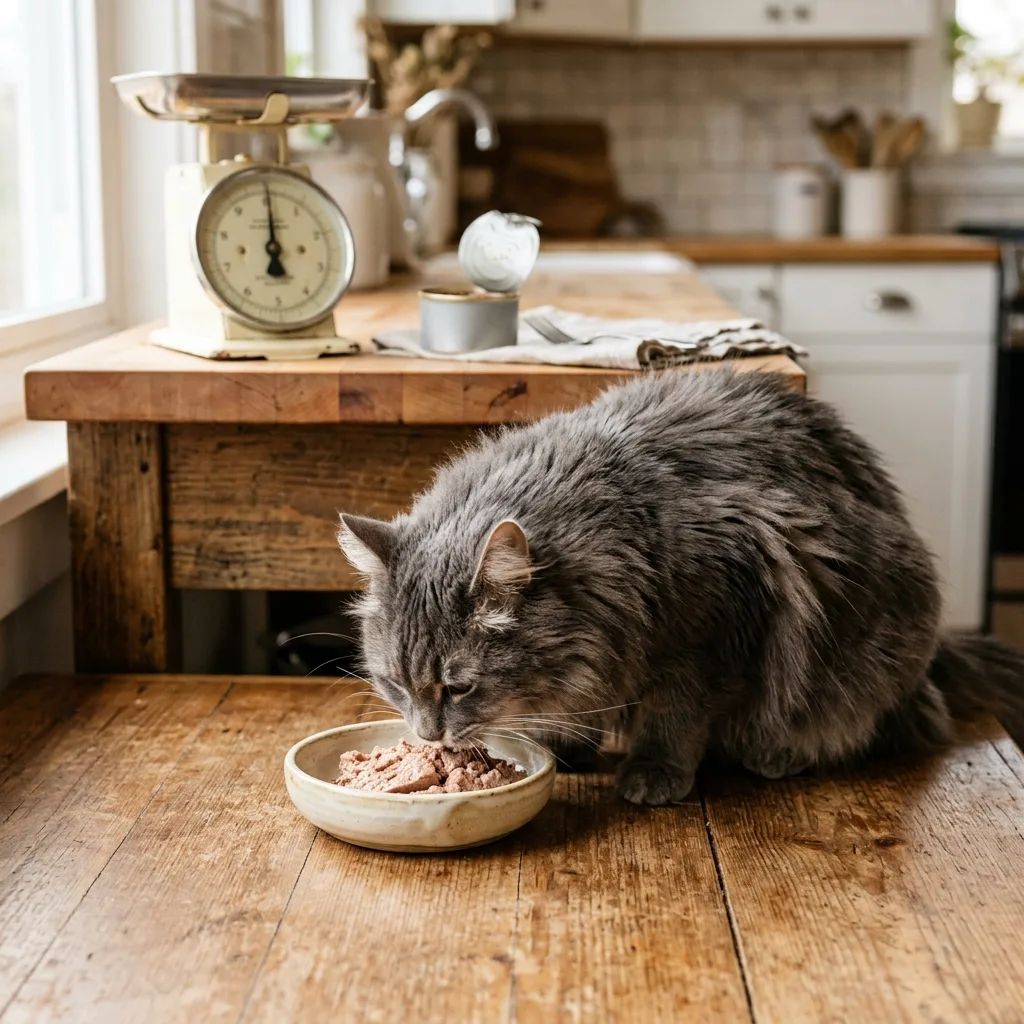
Quick answer: think about 200 calories a day for a typical indoor, neutered cat sitting at a healthy 10 pounds. On most wet foods that works out to 2 or 3 of the little 3 oz cans, or 1 to 1.5 of the bigger 5.5 oz ones, spread over two meals or more. But flip the can over and check, because calorie counts differ a lot between brands.
Daily calories by weight
Rough daily numbers for indoor, neutered grown-up cats already at a good weight. If yours is a zoomies-at-midnight type, add a little. If they mostly nap or are carrying some extra padding, trim it back.
| Cat’s ideal weight | Approx. calories per day | 3 oz cans (about 80 kcal each) |
|---|---|---|
| 6 lb (2.7 kg) | 130 to 150 | about 1.5 to 2 |
| 8 lb (3.6 kg) | 165 to 185 | about 2 to 2.5 |
| 10 lb (4.5 kg) | 195 to 215 | about 2.5 |
| 12 lb (5.4 kg) | 225 to 250 | about 3 |
| 14 lb (6.4 kg) | 250 to 280 | about 3 to 3.5 |
Vets get these from a standard resting-energy formula. Use them as a ballpark, not gospel, and let your vet adjust for your own cat.
How to read the can label
- Find the calorie content on the label, usually written as “kcal per can” or “kcal/kg.” It varies a lot, anywhere from about 60 to over 120 kcal in a 3 oz can.
- Divide your cat’s daily calories by the calories in one can, and that’s how many cans a day.
- Split that into at least two meals.
- Weigh your cat every few weeks and nudge portions up or down by about 10% if they’re gaining or losing.
Feeding wet and dry food together
Mixing wet and dry? Totally fine, just share out the day’s calories between them. So a 10 lb cat might get roughly half from each, about 100 and 100. One warning: dry food is tiny but calorie-packed, and eyeballing it is how cats get chunky. Use a kitchen scale or a real measuring cup.
Kittens, seniors and special cases
- Kittens are growing fast and need two to three times more calories per pound than adults. Feed a proper kitten food, in three or four meals a day. See our new kitten checklist.
- Seniors might need fewer calories, or more if they’re losing weight. Weight loss you can’t explain in an older cat always deserves a vet visit.
- Overweight cats should be fed for the weight they ought to be, not the weight they are now, and any weight loss should be slow and supervised by a vet.
- Pregnant and nursing cats need a lot more food. Ask your vet how much.
Is your cat at a healthy weight?
Run your hand along your cat’s side. You want to feel ribs easily without pressing hard, but not see them. Now peek down from above: there should be a gentle dip, a waist, just behind the ribs. That little swinging belly pouch lots of cats have? Normal. A round, barrel-shaped cat with no waist at all? Probably a few pounds over.
Storing wet food safely
- Wet food shouldn’t sit in the bowl longer than 2 to 4 hours, less on a hot day.
- Pop a lid on opened cans and keep them in the fridge. Around 3 days, max.
- Some cats like their food a little warm. Let fridge-cold food come up to room temperature, or warm it very briefly and give it a good stir.
Wet food FAQs
Is wet food better than dry for cats? Either can be complete and balanced. Wet has the edge on water, though, and that extra moisture really helps a lot of cats, particularly the ones who tend to get bladder trouble.
Why is my cat always hungry? Some cats are just greedy, bless them. But if the begging has ramped up out of nowhere, it can point to hyperthyroidism or diabetes, so get it checked.
How many times a day should I feed my cat? Twice a day at the very least for adults. Lots of cats do better on smaller, more frequent meals, which can also help with vomiting from eating too fast.
Want vet-reviewed nutrition info? The Cornell Feline Health Center is a great resource. And since wet food helps keep cats hydrated, it’s worth a look if you’ve spotted your cat drinking water with her paw.
Leave a Reply