Fresh snow, a muddy flower bed, damp sand at the beach. And there it is: a line of little tracks. Who went by? The neighbor’s cat? Your own dog? Something a bit wilder? At first glance, a cat paw print vs dog paw print can look like twins. Four toes, one big pad. But once you know the tells, it gets easy. And, fair warning, a little addictive.
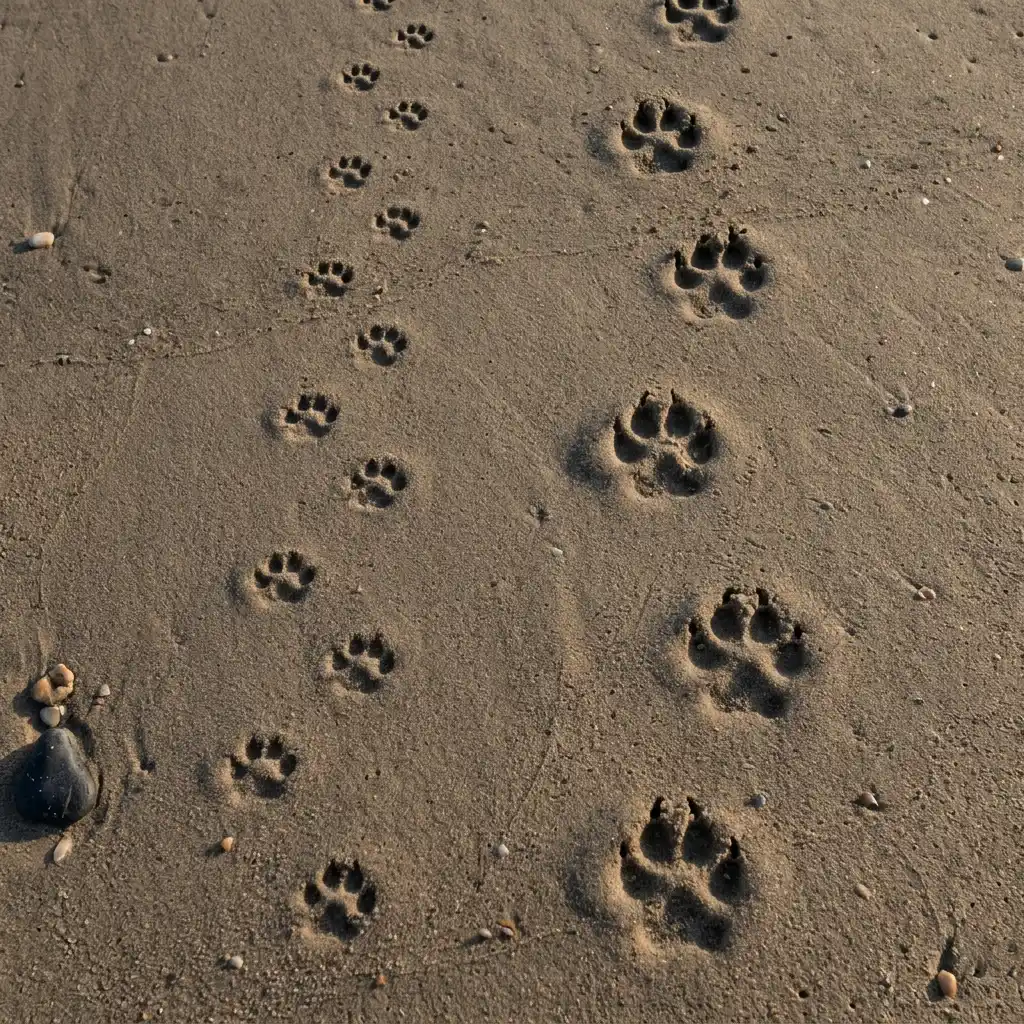
Quick answer: cat prints are round, about as wide as they are long, and usually have no claw marks, since cats keep their claws tucked in when they walk. Dog prints are more of an oval, longer than wide, and usually show little claw marks in front of the toes. Cat prints also have slightly uneven toes and a main pad with three lobes at the back. Dog prints are more symmetrical, with a smaller, triangle-ish main pad.
The anatomy of a paw print
Both cats and dogs walk on their toes, which is why the prints look so alike. A typical print shows:
- Four toe pads (digital pads) in an arc at the front
- One big main pad (the metacarpal or metatarsal pad) behind them
- Claw marks in front of the toes, but only sometimes
Both also have a fifth “thumb” toe, the dewclaw, higher up on the front legs, and it almost never shows up in a normal track. Cats have one more little pad, the carpal pad, even further up the front leg. You might spot it when a cat lands from a jump or walks through soft ground. The real differences are in the shape, spacing and small details.
Cat paw print vs dog paw print: 6 key differences
1. Claw marks
Start here. It’s the fastest clue. Cats can pull their claws in, and they keep them tucked away while walking so they stay sharp for climbing and hunting. So a cat print usually has no claw marks at all. Dogs can’t retract theirs, so you’ll often see little dots or dashes just ahead of each toe. There are exceptions (a cat might flick its claws out for grip on slippery ground or while running), but as a rule of thumb: claw marks, probably dog.
2. Overall shape
Cat prints are round, like a little circle. Dog prints are oval, clearly longer than they are wide. Picture drawing a box around the print. Cat? Fits in a square. Dog? Needs a taller rectangle.
3. Toe arrangement
Now zoom in on the toes. On a dog print, they’re pretty symmetrical, with the two middle toes side by side, both pointing straight ahead. On a cat print, they’re a little lopsided. One toe sits a bit further forward than the rest, kind of like the middle finger on your hand. Trackers use that “leading toe” to tell left paws from right.
4. The main pad
The main pad is one of the most reliable giveaways. A cat’s is big compared to its toes, with three lobes along the back edge and two small bumps at the front. A dog’s is smaller and more triangular, with two lobes at the back and one rounded point at the front. Trackers boil it down to: cats have three at the back, dogs have two.
5. The space between the pads
Here’s a neat trick. On a clear dog print, you can usually draw an “X” through the empty space between the toes and the main pad without touching any pads. On a cat print, the toes hug the main pad more closely, so the X just won’t fit. The open space looks more like a curved “C” instead.
6. The trail pattern
Step back and look at the whole trail. Cats are tidy walkers. Their back paws land almost exactly where the front paws were, leaving a neat, narrow line of single prints, a bit like a dotted line. Dogs wander. They sniff, zigzag, change their minds. Their back paws don’t land as precisely, so the trail looks messier and wider, with prints overlapping or scattered.
Want clear side-by-side diagrams? Bear-Tracker has an excellent guide to canine vs feline tracks, and the Wenatchee Naturalist explains how to read cat and dog trails out in the field.
Quick comparison table
| Feature | Cat paw print | Dog paw print |
|---|---|---|
| Shape | Round, as wide as long | Oval, longer than wide |
| Claw marks | Usually none | Usually visible |
| Toes | A little lopsided, one toe out front | Even, pointing straight ahead |
| Main pad | Big, three lobes at the back | Smaller, triangle-ish, two lobes at the back |
| Negative space | C-shaped | X-shaped |
| Trail | Tidy, narrow, straight line | Wider, wandering, a bit sloppy |
| Typical size (pets) | About 1 to 1.5 inches | Anywhere from 1 to 5 inches, depending on breed |
What about size?
Size helps a little, but on its own it’s the weakest clue. Most house cats leave prints about 1 to 1.5 inches across. Dogs are all over the map. A Chihuahua’s print can be smaller than a cat’s, and a Great Dane’s can be bigger than your palm. So small doesn’t automatically mean cat. Check shape, claws and pads first.
Could it be a wild animal?
If the prints don’t match anyone in your house, you might have a wild visitor. A few common look-alikes:
- Fox: a small, narrow, dog-like oval with a very clear X in the middle and small claw marks. The trail tends to be a neat straight line, more like a cat’s.
- Coyote: like a medium-sized dog but tighter and more oval, toes held close together, and a direct, on-a-mission trail.
- Bobcat: looks like a house cat print, only noticeably bigger, often around 2 inches across.
- Raccoon: five long, finger-like toes, a bit like a tiny human hand. Once you’ve seen one, you won’t mix it up.
Finding big cat-like prints more than 3 inches wide, or other signs of wildlife near your home? Keep pets indoors or supervised, especially at night. Our guide on indoor vs outdoor cats covers ways to keep cats safe and happy.
Tips for reading tracks in the wild
Tracks show up best in fresh snow, damp sand and soft mud, ideally early in the morning before they get trampled or dry out. Low, sideways light at sunrise or sunset throws little shadows that make pad shapes and claw marks pop. Hunt for the single clearest print on the trail instead of guessing from a smudge, and take a photo with a coin or your shoe beside it for scale. Looking at several prints along the same trail will give you a much more confident answer than any one print ever will.
What paw prints can tell you about your pet’s health
Keeping an eye on your own pet’s paws is handy for more than tracking. Things you might notice:
- Lopsided or lighter prints on one side, which can mean your pet is favoring a leg because of pain or an injury. See our paw pad injury guide.
- Claw marks on hard floors from a cat, which may mean the nails are too long. Our guide on how to trim cat nails can help.
- Loud clicking from a dog’s nails, a sign they need a trim, or in older dogs sometimes a sign of thick, hard pads from hyperkeratosis.
- Wet or reddish prints after a lot of licking, which can point to itchy or irritated paws.
How to make a paw print keepsake
Lots of people love keeping a print of their pet’s paw, especially as a keepsake. You can gently press a clean paw into salt dough or air-dry clay, or use a pet-safe, non-toxic ink pad made for paw prints. Keep it short and calm, hand out treats, and wipe the paw right after. Cats in particular aren’t always thrilled about paw handling, so go slowly and stop if your cat looks stressed.
Frequently asked questions
How many toes show in a cat or dog paw print?
Usually four for both. The fifth toe, or dewclaw, sits higher on the leg and rarely touches the ground. Some cats are polydactyl, meaning they have extra toes, and their prints can show five or more toe pads.
Do cats ever leave claw marks in their prints?
Sometimes. A cat may push its claws out for grip on slippery or steep ground, when running or when startled. In most everyday walking tracks, though, cat prints are claw-free.
Are front and back paw prints different?
Yes. In both cats and dogs, the front paws are usually a bit bigger and wider than the back ones, because they carry more of the body’s weight. Back prints tend to be slightly smaller and narrower.
What is the easiest way to tell a cat print from a dog print?
Check claw marks and overall shape first. Round and no claws? Probably cat. Oval with little claw dots? Probably dog. Still not sure? Look at the main pad: three lobes at the back for a cat, two for a dog.
Why do some paw print designs mix up cat and dog features?
Most paw print icons on logos, stickers and tattoos are simplified, generic shapes. They often mash a round, cat-like pad together with dog-like spacing. If you want a design that really looks like your own pet, a real print of their paw is the best way to capture the details.
Leave a Reply