
One fly. That’s all it takes. It sneaks in through the back door and suddenly your 70-pound dog is wedged behind the couch, shaking like it’s a thunderstorm. So why is my dog scared of flies? Mostly because that buzz sounds way louder to a dog than it does to you, flies move like little lunatics, and some of them bite. Hard.
Usually it’s nothing serious, and you can fix it at home. Usually. If the fear showed up out of nowhere, or your dog snaps at flies that aren’t actually there, that’s a different story (and one your vet will want to hear).
Oh, and if you landed here because this just started at your house? You’ve got company. Google Trends shows US searches for this exact question went up more than 2,000% over the past three months. There’s a seasonal reason for that, which I’ll get to further down.
Quick Facts: Dogs and Their Fear of Flies
- Common? Very. Lots of dogs hate anything that buzzes, the nervous ones most of all.
- Dangerous? The fear on its own, no. But fear that pops up overnight, or air snapping, needs a vet visit.
- Usual causes: a bite that hurt, super sharp hearing, random fly movement, one bad memory, pain somewhere in the body, general anxiety, or a medical thing called fly biting.
- Fixable? Pretty much always, though it takes a while. Figure somewhere around two to six weeks if you go slow and don’t rush it.
- Call the vet if: the fear came on out of nowhere, or you’re also seeing air snapping, lots of lip licking and gulping, a limp, or a dog who’s suddenly fussy about dinner.
In this guide
- Why Dogs Are Scared of Flies: The Short Answer
- Signs Your Dog Is Afraid of Flies (Not Just Playing)
- 7 Reasons Your Dog Is Scared of Flies
- Why Is My Dog Suddenly Scared of Flies?
- Fly Biting Syndrome: When Snapping Isn’t Fear
- Why This Gets Worse in Fall: Cluster Flies
- How to Calm a Dog Scared of Flies Right Now
- A 2-Week Plan to Help Your Dog Stop Fearing Flies
- Fly Control That’s Safe for Dogs (and Cats)
- Mistakes That Make Fly Fear Worse
- FAQ
Why Dogs Are Scared of Flies: The Short Answer
Put yourself at dog height for a second. There’s this whiny little thing zipping past your nose with no pattern at all, and every so often one of them actually stings. After one bad run-in, the sound alone is enough. Doesn’t matter if this particular fly is harmless. Your dog isn’t taking the chance.
You probably do the same thing with wasps, right? Nine times out of ten the wasp ignores you. You still duck.
And dogs get way more fly exposure than we do. They’re down at nose level with the food bowl, the trash bag, the lawn, the neighbor’s horse. Flies end up right in their face. Literally.
Signs Your Dog Is Afraid of Flies (Not Just Playing)
Careful, though. Plenty of dogs chase flies because it’s fun, and that’s not fear at all. Watch your dog, not the fly, and the answer’s usually pretty obvious.

Here’s roughly how the two look side by side:
| What you see | Fear | Play or curiosity |
|---|---|---|
| Tail | Low or tucked between legs | Up, loose, wagging |
| Ears | Pinned back or flat | Forward, alert |
| Body | Crouched, trembling, backing away | Bouncy, leaning in |
| Face | Lip licking, yawning, whale eye (whites of eyes showing) | Soft mouth, relaxed eyes |
| Action | Hides, leaves the room, won’t go outside | Chases, jumps, snaps happily |
You might also see panting on a cool day, pacing around the kitchen, a dog who won’t touch a treat they’d normally inhale, or one who’s suddenly glued to your shins (the thunderstorm look, basically). We cover how fear, cold and pain can all look alike in why your dog shakes or trembles.
7 Reasons Your Dog Is Scared of Flies
It’s rarely just one of these, to be fair. Most fly-phobic dogs have a couple stacked on top of each other, but there’s usually one doing most of the damage, and that’s the one to go after first.
1. A Fly Bite Hurt Them
Not every fly is a harmless housefly. Stable flies go straight for the tips of pointy ears. Black flies like bare bellies. Horse flies and deer flies? Those actually rip skin. One good bite and every buzz after that sounds like trouble.
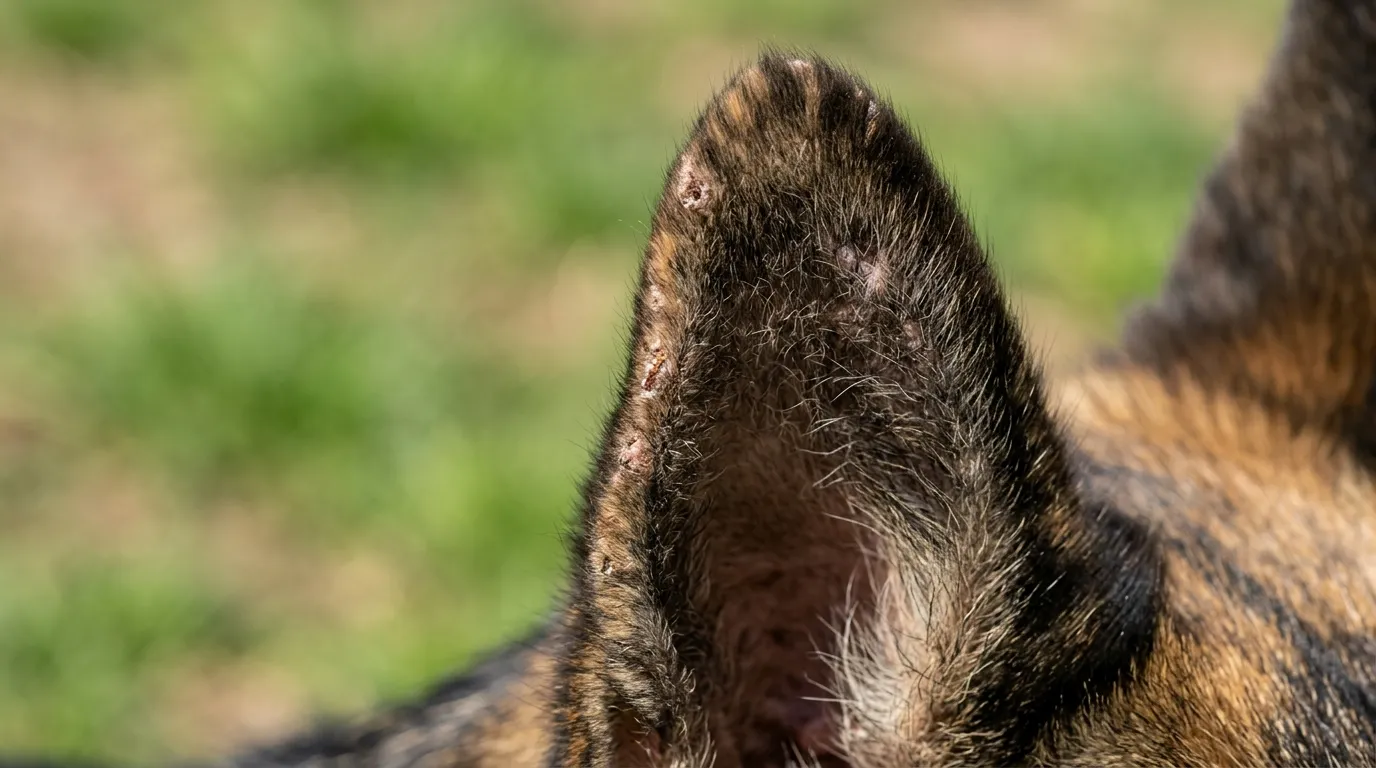
Next time your dog rolls over for belly rubs, have a look at the ear edges and tummy while you’re down there. Tiny scabs or crusty dots of dried blood give it away, and dogs who spend time near barns, horses or ponds get them way more.
2. Their Hearing Is Much Sharper Than Ours
Human ears quit at about 20,000 Hz. A dog’s keep going to somewhere around 45,000, and they hear soft stuff from much farther away than we do, so the fly you can barely hear tapping on the kitchen window is, to them, a shrill whine that never stays at one pitch long enough to get used to.
3. Flies Move in Ways Dogs Can’t Predict
Balls are easy. You throw, they go. Flies zig, stop dead, dive at your eyeball, vanish, come back. Dogs don’t love things they can’t predict, which is also why a random bang scares them more than a steady hum.
4. One Bad Moment Became a Habit
A fly crawling into an ear mid-nap would do it. So would that bee your dog grabbed in the yard last summer. One rotten experience is plenty, and dogs aren’t great at telling insects apart, so the lesson they walk away with is less “bees hurt” and more “anything that buzzes is out to get me.”
5. Hidden Pain Is Making Them Jumpy
This is the one most owners never think of. A 2018 study in Frontiers in Veterinary Science found that dogs dealing with muscle or joint pain got noise-sensitive more than pain-free dogs did. The theory goes something like this: a sudden sound makes a sore dog jump, the jump tweaks whatever already hurts, and the dog files the sound under “causes pain.” Every dog in that study who got pain treatment improved behavior-wise.
6. They’re Generally Anxious or Sound-Sensitive
Is your dog also weird about the vacuum? The smoke alarm? Thunder? Then flies are probably just one more item on a longer list of sounds they hate. If sirens set your dog off too, here’s why dogs howl at sirens.
7. A Medical Problem Called Fly Biting
Some dogs bite at the air like they’re catching invisible flies. That’s not fear. It’s a medical sign, so it gets its own section below.
Why Is My Dog Suddenly Scared of Flies?
If your dog spent years totally ignoring flies and now falls apart over a single one, something shifted, whether that’s a recent bite, a health problem brewing, or just more stress at home than usual.
Ask yourself:
- Any bites or sore ears lately? The ear tips, belly and inside of the back legs are where you’ll spot them.
- Is your dog getting older? In that 2018 pain study, dogs with pain started being afraid of noises about four years later in life, on average, than dogs without pain. A fear that shows up late is worth a vet check.
- Anything new at home? Moving, a baby, another pet, you going back to the office. All of it can crank up a dog’s baseline anxiety.
- Other new stuff? Things like limping, being stiff getting up, lip licking, gulping, chowing down on grass or getting picky with food usually mean the body’s involved, not just nerves.
My rule of thumb is simple. New fear plus any physical change? Vet first, training second.
Fly Biting Syndrome: When Snapping Isn’t Fear
Fly biting (people also call it fly catching or fly snapping) is when a dog snaps at empty air, often looking up, like there’s a fly only they can see. It’s a medical sign, not fear. Vets usually tie it to small focal seizures or to stomach trouble.

For years everyone blamed seizures or compulsive behavior. Then a small 2012 study out of the University of Montreal checked 7 fly-biting dogs and found gut problems in most of them, things like reflux and an inflamed stomach. Treat the gut, and in most of those dogs the snapping got better or stopped.
Veterinary neurologists at the MSPCA-Angell now say they’ll often try stomach meds first if the neuro exam comes back normal. They compare it to a condition in kids where reflux pain causes strange neck movements. Pretty wild, honestly.
Cavalier King Charles Spaniels seem to do it more. Any breed can, though.
Get a vet appointment if your dog:
- snaps at the air when there’s no fly
- does it more right after eating
- also licks their lips, gulps, or eats a lot of grass (more on that in why dogs eat grass)
- looks spaced out or won’t respond to their name while it’s happening
Grab a phone video of an episode if you can. Vets love those. It saves a ton of guessing.
Why This Gets Worse in Fall: Cluster Flies
Noticing more fly drama lately? Could be the time of year. Every fall, cluster flies move into houses to wait out winter. Colorado State University Extension says they start sneaking in around late August, and most are inside by September.

They tuck themselves into attics and walls, then wake up whenever there’s a warm sunny day and bumble around the windows. Slow, loud, clumsy flies, showing up in your living room on and off for months. For a sound-sensitive dog that’s basically a nightmare.
The upside is that cluster flies don’t feed on blood, so nobody’s getting bitten. Sealing the gaps around window frames and siding is the real fix, and a handheld vacuum takes care of the stragglers already inside.
How to Calm a Dog Scared of Flies Right Now
Fly in the room, dog panicking? Skip the training for now. Just bring the stress down.
- Keep your own voice normal. Dogs pick up on your mood fast.
- Get the fly out quietly. Open a window, use a fly catcher, or vacuum it. Chasing it around with a swatter and a lot of slapping makes things worse.
- Offer a hideout. A crate with a blanket thrown over it works for a lot of dogs, or a back bedroom with a fan running so the buzz gets drowned out.
- Give them a job for their mouth. A lick mat or a stuffed Kong works wonders for a lot of dogs.
- Let them come to you. No, comforting a scared dog doesn’t “reward” fear. That’s an old myth. Calm petting is fine.
If your dog is trailing you from room to room in these moments, that’s a pretty normal worried-dog move. Here’s more on why dogs follow you everywhere.
A 2-Week Plan to Help Your Dog Stop Fearing Flies
The official term, if you want to google it later, is desensitization and counterconditioning. What it means in practice: you play a buzzing sound so quietly your dog barely registers it, hand over something amazing every time, and creep the volume up over days. Eventually the buzz means “chicken is coming,” not “run.”

If you’ve never done training like this, honestly don’t worry, there’s nothing tricky about it beyond not getting impatient.
You’ll want a fly buzzing clip (YouTube has loads of them), your phone, and a pocket full of the good stuff, little bits of chicken or cheese rather than the dry biscuits your dog shrugs at.
| Days | Volume | What you do | Move on when |
|---|---|---|---|
| 1-3 | Barely audible, speaker in another room | Play 5-10 seconds, then treat. Repeat 5 times. | Dog ignores the sound or looks at you for treats |
| 4-6 | Low, same room, 3 meters away | Sound on, treats flow. Sound off, treats stop. | Relaxed body, eats easily |
| 7-9 | Medium, 1-2 meters away | Add short play or a sniff game while the sound plays | No crouching, lip licking or leaving |
| 10-12 | Medium, moving the phone around | Mimic a fly’s random movement while you treat | Dog stays loose and curious |
| 13-14 | Real life | Reward calm behavior when a real fly appears | Dog can stay in the room with a fly |
Three to five minutes a session is plenty. When your dog stops taking food, starts crouching or wanders off, that’s your sign you went up too quick, so just drop back a step for a day or two and try again.
Some dogs need more than two weeks. Totally fine. For the really panicky dogs, a board-certified veterinary behaviorist is worth it. They can build a custom plan and, where it fits, go over anxiety medication with you.
Fly Control That’s Safe for Dogs (and Cats)
Fewer flies, fewer meltdowns. Easy math. Just watch out, because a lot of “natural” fly sprays aren’t actually pet safe.
PetMD puts tea tree oil, citronella, geranium oil and garlic oil on its list of ingredients that can be toxic to dogs, which is a bit alarming considering how many “natural” fly sprays lean on exactly those, so run any product past your vet first.
Things that help without the risk:
- Screens. Patch the torn ones and seal gaps around window frames.
- Sticky traps and fly catchers, hung where your dog can’t get to them.
- Less fly food. Scoop poop every day, put a lid on the trash, don’t leave food bowls sitting out.
- Ear protection. Dogs who keep getting chewed up on the ears might do well with a pet-safe barrier ointment or a fly mask outdoors, and your vet can point you to one.
- Vet-approved products only. Some flea and tick products repel biting flies too. Your vet will know which one fits.
Got a cat too? Read this: dog products with permethrin can be very toxic to cats. Keep the cat away from a dog you just treated, and never, ever use a dog product on a cat.
Mistakes That Make Fly Fear Worse
Nobody does these on purpose. Still, they backfire:
| Mistake | Why it backfires | Do this instead |
|---|---|---|
| Swatting flies loudly near your dog | Adds a bang to the buzz, so the fear grows | Remove flies quietly with a catcher or vacuum |
| Forcing your dog to “face” a fly | Flooding often makes fear worse | Go slowly with the 2-week plan |
| Scolding a scared dog | Adds stress, teaches nothing | Stay calm and give a safe spot |
| Turning the training sound up too fast | Dog learns the sound is still scary | Stay at a volume your dog can eat through |
| Skipping the vet for sudden fear | Misses pain, bites or stomach problems | Rule out medical causes first |
FAQ
Can dogs hear flies?
Oh yes, a lot better than you can. Their hearing reaches roughly 45,000 Hz while ours stops near 20,000, and they catch much fainter sounds too, so a buzz you’d barely clock in a quiet house comes across loud and piercing to them.
Why does my dog snap at flies that aren’t there?
What you’re seeing is probably fly biting, which vets treat as a medical issue rather than a fear thing, with links to small focal seizures and to stomach trouble such as reflux. Get it on video if you can and take that to your vet, who might start with stomach meds or a neuro workup.
Is fly biting a seizure?
It can be. Some veterinary neurologists class certain cases as focal seizures, but there’s also decent evidence pointing at gut disease, and plenty of dogs got better once their stomach was treated, so most vets check both angles, starting with a full physical and neuro exam.
How do I calm my dog when a fly is in the house?
Keep your own energy low, get the fly out without a big chase, and steer your dog somewhere quiet with a fan or white noise going. Lick mats and chews help a lot of dogs come down, and a bit of gentle comfort from you won’t make the fear any worse.
Are fly sprays safe for dogs?
Depends on the spray. Lots of the “natural” ones lean on tea tree oil, citronella and similar oils that can hurt dogs, so only use what your vet signs off on, and be extra careful with permethrin products if a cat lives with you, since it’s very toxic to them.
Will my dog grow out of being scared of flies?
Some dogs do mellow out on their own, but it’s more common for it to slowly get worse, since every bad fly moment reinforces the fear a bit. Gentle sound training, fewer flies indoors and a vet check for pain together give your dog a real chance of improving within a few weeks.
One Last Tip Before Fly Season Peaks Again
Do the sound training on a calm, fly-free day. Not in the middle of an invasion. Dogs learn best when they already feel safe.
Give the 2-week plan a go, then pop back and tell us in the comments how it went. Was it a bite that started it all, or did it come out of the blue? Your story could really help someone else’s scared pup. And if your dog has other odd habits, why dogs shake and tremble is a good one to read next.
This article is for general information and doesn’t replace advice from your veterinarian. If your dog’s behavior changes suddenly, please contact your vet.
Leave a Reply